
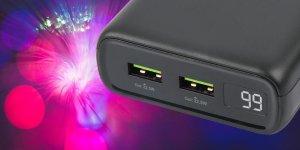



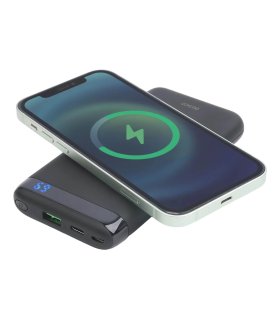

- 10000mAh (37Wh) Li-Poly battery Powerbank- USB-C PD (USB Power Delivery) input/output port- USB-A port with 'Fast Charge' support- 10W Qi certified Wireless Charging with Magnet- LED Display (battery & charging...
Which PowerBank capacity (mAh) should I choose?
62138
Love85
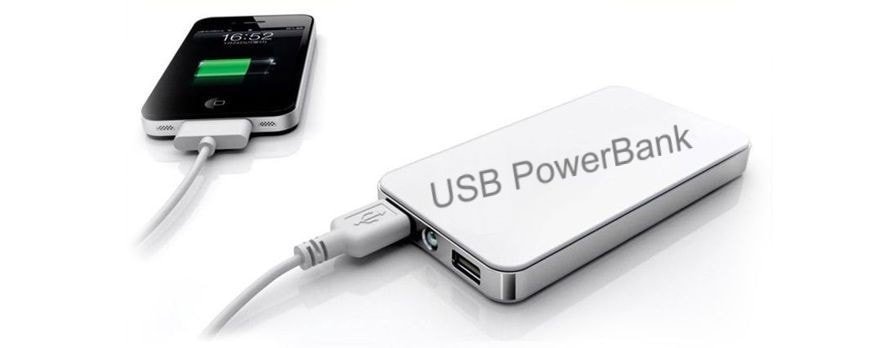
Powerbank Capacity vs Size and Weight
The capacity (mAh) is related to the size and weight of the Power Bank. A Power Bank with a high capacity (mAh) will therefore typically weigh and take up more space than a Power Bank with lower capacity. Newer generations of Power Banks (more expensive/better battery technology) can typically store more energy in less space compared to cheaper mainstream Power Banks.
Li-Polymer based PowerBanks are typically slimmer and lighter compared to Li-ion based Powerbanks, which usually can have a smaller total footprint then.
How much can the USB PowerBank charge?
How many times you can charge your devices depends partly of the PowerBank capacity (mAh), set against the battery capacity (mAh) of the devices you want to charge.
Smartphone batteries typically have between 2000-5000mAh capacity. More powerful devices such as iPad / Tablets are normally between 6000-12000mAh. You can usually find the battery capacity (mAh) ratings on your various devices, in the manual / manufacturer documentation.
For example the iPhone 16 has a 3561mAh rated battery, so divided up with a 10000mAh Power Bank, will theoretically give you 2.8 recharges - but you cannot really calculate it that easy...
It also require energy to convert the power!
Both the PowerBank and the equipment to be charged consume some power during the transfer and voltage conversion. There will also be a natural loss in the cables and conditions such as temperature, humidity and not least wear at both ends. There can also be different power consumption/waste when charging from 0-30% compared to 40-80% etc.
In other words, you can't just divide the PowerBank's capacity by the device's battery capacity. A rule of thumb is that about 15-25% is "lost" just for the above conditions. A poor/cheap PowerBank can easily have up to 25-50% energy loss.
You can typically use this formula to roughly estimate the number of charges:
Current PowerBank capacity X Average conversion rate / actual Mobile battery capacity = Number of charges
iPhone 12: 10.000 x 0,8 / 2815 = 2.84 times (+/- 0.5-1 times)
iPhone 16: 10.000 x 0,8 / 3561 = 2.25 times (+/- 0.5-1 times)
Samsung Galaxy S25: 10.000 x 0,8 / 4000 = 2 times (+/- 0.5-1 times)
Is your device on while being USB charged?
One should also remember that if the device is ON while being charged, it also means up to double power consumption. In this case the Power Bank both have to charge the battery and keep the device operated at the same time.
It may also give some varied results if you put different Power Bank up against each other, even though they may have the same specified capacity. The battery cells may well deliver 10000mAh (1A for 10 hours at the given voltage) - but in practice it constantly differ in both power bank and the receiving device. Some are more / less efficient or faster / slower at certain charging intervals, temperature and humidity is a factor, cables, wear and then there is the matter of 'Overhead': When the electronics (both in Power Bank and Receiver) report their battery as full and empty, there is actually still some available capacity at both ends, to protect the battery and ensure longer battery life.
USB PowerBanks with fake rated capacity!
A low-quality/no-name/cheap Powerbank will typically also have significantly worse energy efficiency than a good Powerbank, such as those from Chill Innovation. This means that a larger proportion of the capacity is used to power the Powerbank itself and transfer/convert the power. Therefore, there is less left for the device that needs to be charged.
The stated capacity is often also cheated on in most cheap Powerbanks that do not come from reputable brands/manufacturers. Since battery cells are clearly the most expensive (but also the most important!) elements in a Powerbank, it is unfortunately very common and easy to cheat with the capacity. For example, a cheap Power Bank with a stated capacity of 20,000mAh may in practice only actually deliver 10,000-15,000mAh or even less. It is impossible for ordinary people to check for themselves, but it appears both better and cheaper - and then you pull out your credit card ;-)
If you want high capacity and minimal size/weight, it also requires the latest and most advanced battery technology with higher energy density. These are of course more expensive than mainstream cells, so you rarely find such cells in cheap consumer/China Powerbanks. It is also not uncommon for many cheap Chinese brands to advertise that they use Samsung and LG cells, etc. to appear better - but this is typically fake.
If you want the best Powerbanks, avoid the cheap "no-name" Powerbanks and be critical when you come across relatively high stated capacity at low prices. If you stick to more reputable brands, they are unlikely to risk their reputation by cheating on capacity, quality and safety.
All Chill/Deltaco Powerbanks from Chill Innovation are always specified according to the real battery capacity!
Related products


- 10000mAh (37Wh) Li-Poly battery Powerbank- Ultra Slim Design (only 16mm)- 1x USB-C PD (USB Power Delivery) in/out port (max 20W)- 2x USB-A port with 'Fast Charge' support (max 18W)- 1x Micro-USB input (max 18w)-...


- 20000mAh (74Wh) Li-Poly battery Powerbank- 1x USB-C PD (USB Power Delivery) in/out port (max 20W)- 2x USB-A port with 'Fast Charge' support (max 18W)- Fast Charging & USB Power Delivery support- LED lights...
Related articles


 English
 Dansk
Dansk
 Norsk
Norsk
 Svenska